The Loneliest Photograph Ever Taken
Carl Sagan had been asking NASA for years.
One photograph. Before Voyager 1’s cameras shut down permanently, turn them around. Look back. Photograph Earth from the edge of the solar system.
The engineers kept saying no.
The request seemed pointless. Voyager had already completed its mission: Jupiter and Saturn photographed, data transmitted, scientific objectives achieved. The spacecraft was heading toward interstellar space. Its imaging system, designed for planetary encounters at close range, would be useless for the long journey ahead.
Engineers were preparing to shut down the cameras to conserve power.
Why waste resources on a photograph that would produce no scientific data?
From four billion miles away, Earth would barely register on the sensors. The planet would appear smaller than a single pixel. Worse, pointing the cameras back toward the Sun risked damaging sensitive instruments with scattered light.
There was no new geology, no atmospheric measurements. No useful information at all.
Just a faint blue speck in a band of sunlight. Sagan didn’t care about the science. He wanted perspective.
The Technical Challenge
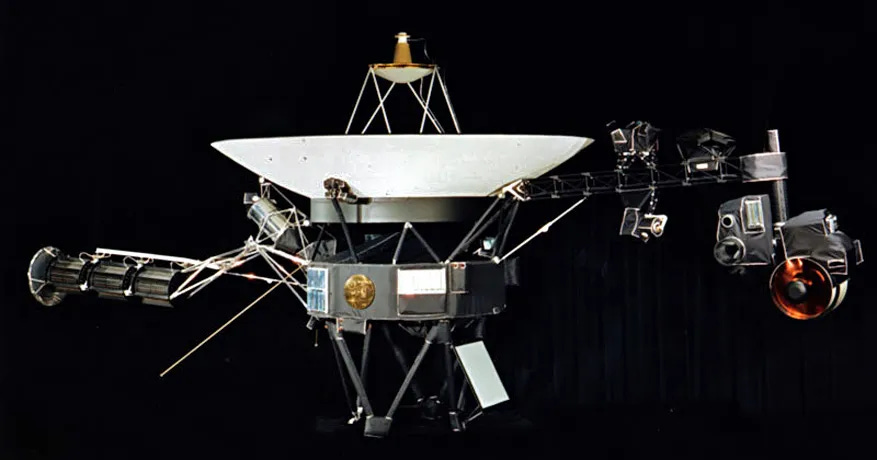
Voyager’s imaging system was never designed for this kind of shot. According to NASA’s Voyager camera documentation (opens in a new window), the cameras were built to capture volcanic activity on Jupiter’s moon Io, the intricate structure of Saturn’s rings, atmospheric storms on gas giants, all at relatively close distances where detail matters.
Four billion miles is a different problem entirely.
At that distance, you’re not photographing a planet. You’re photographing light: a tiny signal of reflected sunlight traveling across nearly the entire span of the solar system. The challenge isn’t composition or exposure. The challenge is proving the signal exists at all.
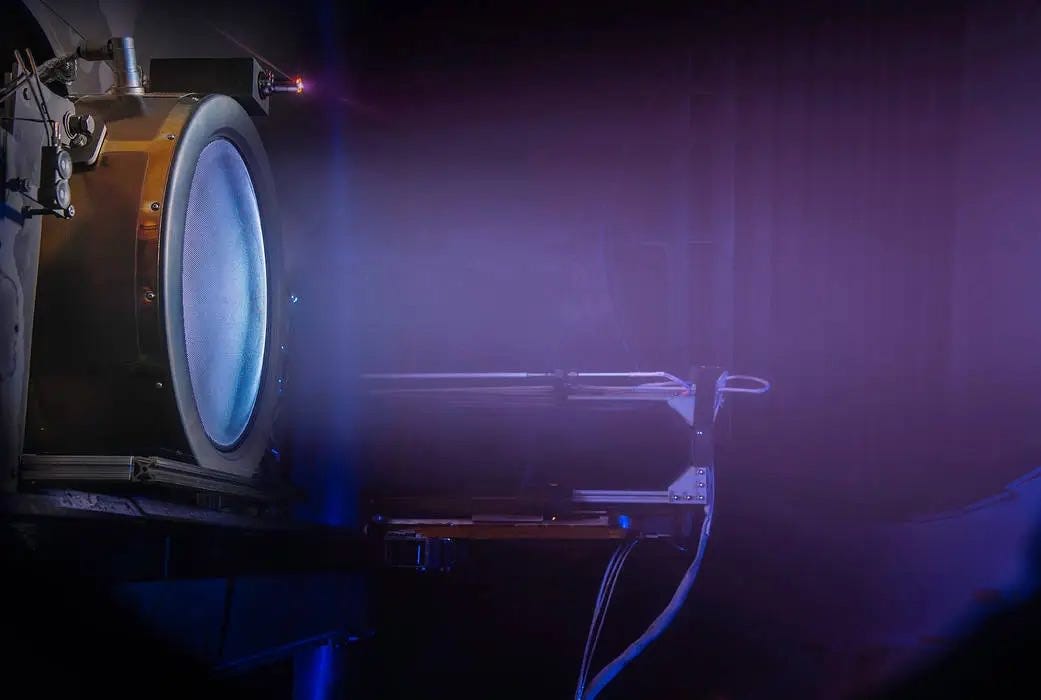
I’ve photographed ion thruster tests where the plasma glow is so faint you need long exposures just to make it visible on the sensor. Even then, you’re never sure if what you’re capturing will register as more than noise until you review the files afterward.
That’s the photographer’s version of what Sagan was asking for.
Except instead of a thruster in a vacuum chamber, he wanted a photograph of the entire planet from the edge of the solar system. And instead of a controlled lab environment, he was working with a spacecraft built in the 1970s, powered by decaying plutonium, operating on equipment that had been exposed to radiation and micrometeorite impacts for thirteen years.
The shot was technically absurd.
Which is probably why it mattered.
February 14, 1990
After years of discussion, NASA finally agreed.
According to NASA’s own account of the photograph (opens in a new window), Sagan first proposed the idea in 1980, following Voyager’s Saturn encounter. It took eight years of repeated requests to get approval. The main objection: pointing the cameras toward the Sun risked irreparable damage to instruments on a mission that had cost $865 million. Only after Voyager 2 completed its Neptune encounter, when there were no more planets to photograph, did NASA Administrator Richard Truly greenlight the picture.
On Valentine’s Day 1990, Voyager 1 began turning its cameras back toward the inner solar system.
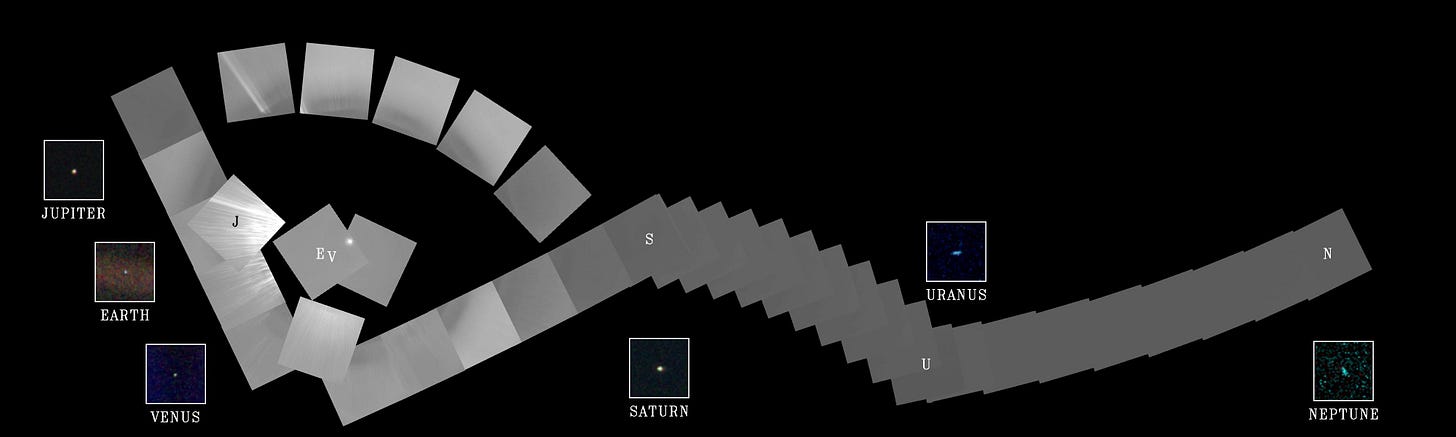
The spacecraft captured sixty frames, what became known as the Family Portrait of the Solar System. From that distance, the planets appeared as small points of light scattered across darkness.
Mercury. Venus. Earth. Mars. Jupiter. Saturn. Uranus. Neptune. Each one suspended in black space.
But one frame became something different.
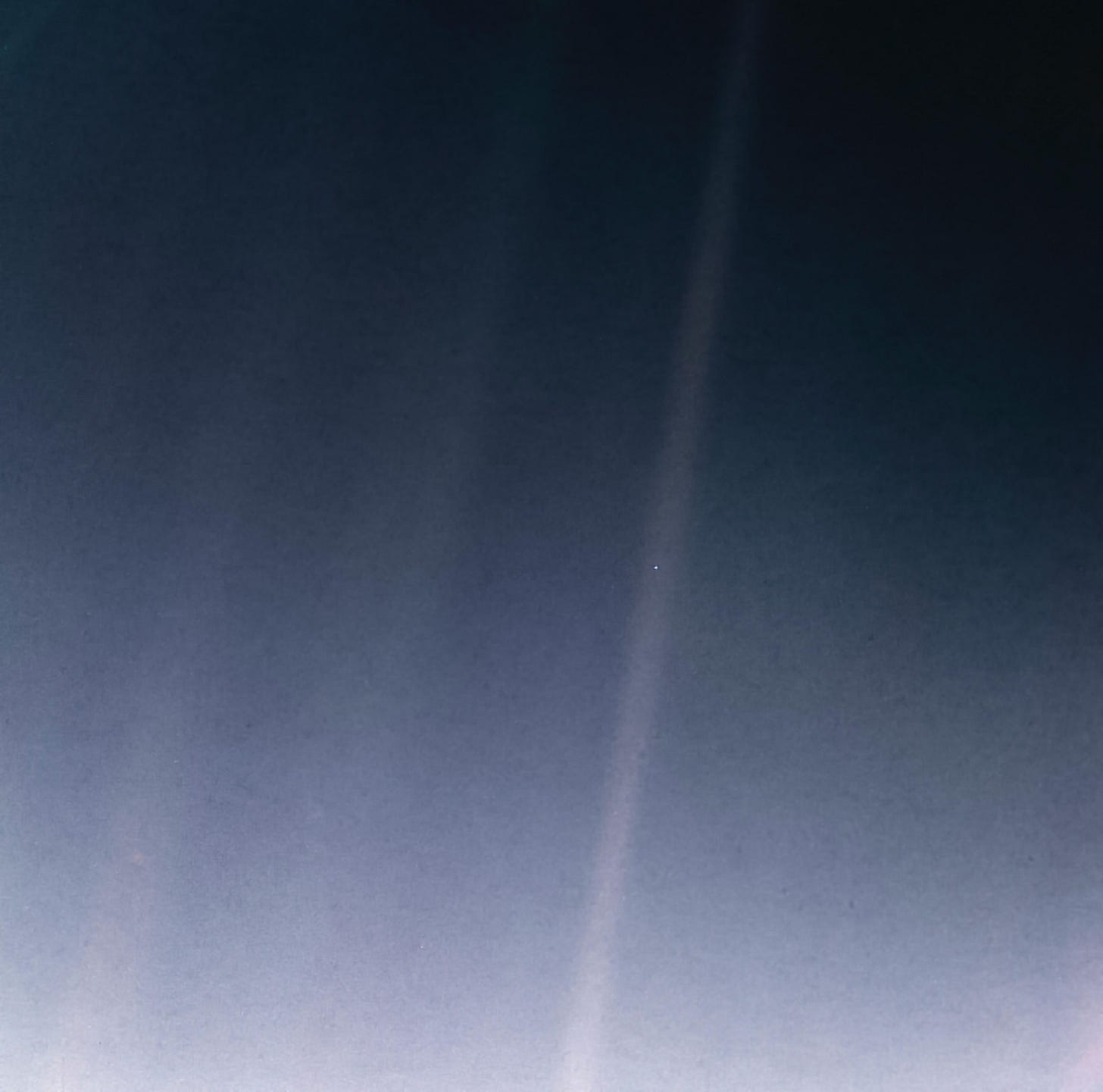
In that image, Earth appears not as a world, but as a faint blue speck embedded in a band of scattered sunlight.
A pale blue dot.
The planet is barely visible. If you didn’t know what you were looking at, you’d miss it entirely.
What Photography Removes
Most photographs depend on detail.
Composition. Texture. Color. Contrast. The ability to see something clearly enough to understand what it represents.
Pale Blue Dot removes nearly all of that.
There are no recognizable landmarks. No continents. No oceans. No clouds. No borders. No visual clues about scale except the knowledge of how far away the camera was.
The photograph works because of what isn’t there.
This is rare in photography: images that become more powerful as they become less detailed. Where the act of removing information creates meaning instead of destroying it.
I’ve spent enough time in clean rooms and test facilities to know that technical documentation lives and dies on detail. Engineers need to see every component, every connection, every potential failure point. One blurry photograph of a thruster mount can render an entire test sequence useless.
But communication works differently.
Sometimes the most effective image is the one that strips everything away except the thing that matters most.
Earthrise worked because it showed Earth as vibrant and detailed: blue oceans swirling with white clouds above a gray lunar horizon. The planet filled the frame. You could see it was alive.
Pale Blue Dot worked because it showed Earth as almost nothing.
The distance collapses all detail into a single point of light.
A fraction of a pixel. The entire planet.
And in doing so, it changes what the image means.
What Sagan Saw
In Pale Blue Dot, published four years after the photograph was taken, he wrote:
“Look again at that dot. That’s here. That’s home. That’s us. On it everyone you love, everyone you know, everyone you ever heard of, every human being who ever was, lived out their lives.”
He continued describing everything contained in that fraction of a pixel: every civilization, every war, every scientific discovery, every piece of music, every moment of human history.
All of it suspended in a beam of scattered sunlight.
Sagan was doing what photographers do when an image works, he was making explicit what the photograph implied.
Earthrise was a call to action. Pale Blue Dot was something harder to name. More like a reality check than a rallying cry.
Why This Image Matters Differently
Earthrise sparked the environmental movement. We traced that connection in the last post. The photograph appeared in January 1969, and sixteen months later, twenty million Americans participated in the first Earth Day. Legislation followed. The EPA. The Clean Air Act. The Clean Water Act. The Endangered Species Act.
One photograph helped catalyze tangible political change.
But what did Pale Blue Dot change?
The photograph appeared in 1990, more than twenty years after Earthrise. The environmental movement was already established. The major legislation was already in place. The public already understood, at least conceptually, that Earth was finite and fragile.
There was no Pale Blue Dot Act. No immediate policy shift. No measurable legislative response.
And yet the image became something else entirely.
Not Policy. Perspective.
Sagan’s book became a touchstone for a different kind of environmental awareness. Not the kind that mobilizes for specific legislation, but the kind that reframes how we think about conflict, borders, and what actually matters at cosmic scale. In 2023, the Library of Congress selected the audiobook for preservation (opens in a new window) in its National Recording Registry as “culturally, historically, or aesthetically significant.”
The image showed up in classrooms, museum exhibitions, and space advocacy campaigns. The Planetary Society, co-founded by Sagan (opens in a new window), used it to argue for continued space exploration. The European Space Agency named its planetary defense program (opens in a new window) after it: “Protecting our Pale Blue Dot.”
Frank White named it the “overview effect” in 1987, the cognitive shift astronauts experience when seeing Earth from space. Later research (opens in a new window) found that viewing images like Pale Blue Dot could trigger the same response: feelings of awe, connectedness, and what researchers called “self-transcendence.” Not policy change. Perspective change.
The Image That Shows What Earthrise Conceals.
Writing in Aeon, philosopher Tim Bayne put it this way: Earthrise reveals Earth’s life-supporting capacities: the vibrant blue oceans, the swirling clouds, the visible continents. Pale Blue Dot conceals all of that (opens in a new window). It shows only scale. Only isolation. Only the vastness of space in which Earth is a barely visible signal.
Earthrise was a call to action. Pale Blue Dot was a reminder of context.
Earthrise arrived at the right moment, when the environmental movement needed a unifying image, when legislation was being written, when the public was ready to act. It gave people something concrete to protect.
Pale Blue Dot arrived two decades later, when the challenge wasn’t mobilization. It was maintaining perspective. When arguments about borders, resources, and nationalism threatened to obscure the fact that all of human history takes place on a single, shared, isolated world.
The photograph doesn’t tell you what to do. It tells you where you are.
What It Changed (And Didn’t)
The image didn’t create a movement. But it became a reference point.
When arguing about climate policy, someone invokes the Pale Blue Dot.
When debating space exploration funding, someone invokes the Pale Blue Dot.
When discussing nuclear weapons, international conflict, or the allocation of resources, someone invokes the Pale Blue Dot.
It operates more like a philosophical principle than a campaign poster. A way to step outside immediate concerns and ask: What does this look like from four billion miles away? What still matters when you can’t see borders?
That’s harder to measure than legislation. But I think it might actually last longer.
Earthrise catalyzed specific policy changes that could be tracked, quantified, and dated. Pale Blue Dot became part of how people think, a frame of reference that shifts the scale of the conversation without necessarily changing the immediate outcome.
Maybe that’s enough.
Or maybe it’s too abstract to count as impact at all.
I’m not sure which.
Where Voyager Is Now
Voyager 1 is now more than 16 billion miles from Earth. Check TheSkyLive (opens in a new window) for the current number, which changes by the hour.
Still traveling outward at roughly 38,000 miles per hour. Still transmitting data, though the signal is so faint that NASA needs massive radio dishes to detect it at all. According to CNN’s reporting (opens in a new window), Voyager 1 will reach one light-day from Earth in 2026, a milestone no human-made object has ever reached.
The spacecraft will continue drifting through interstellar space for tens of thousands of years. Long after human languages evolve. Long after cities change shape. Long after the people who built it are forgotten.
It carries a golden record, an archive of human sounds, music, and greetings, intended for any intelligence that might one day find it.
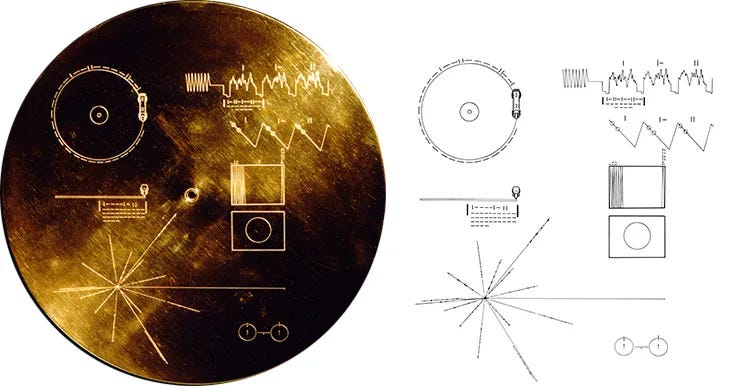
But the most meaningful message Voyager sent may have been the photograph it took before leaving the solar system behind.
A portrait of home, from 3.7 billion miles away.
The Perspective That Remains
Earthrise revealed our planet as a single, shared home. An image that helped unify the environmental movement, catalyze legislation, give people something concrete to protect.
Pale Blue Dot showed us the scale of that home. How small it is. How isolated. How dependent we are on that one faint signal of light.
And sometimes what we see is uncomfortable.
One pixel, one planet; everything we are.
Sources and further reading
- For readers who want to go deeper: Carl Sagan’s Pale Blue Dot remains essential, especially the opening chapter. NASA’s Voyager mission archives contain the full technical record of how the photograph was made. Tim Bayne’s essay in Aeon on the psychology of cosmic insignificance is worth your time. Link to this source (opens in a new window)