From Space Photo to Environmental Movement in 16 Months
On December 24, 1968, Bill Anders raised a camera to a small window on Apollo 8 and photographed the Earth. Sixteen months later, twenty million Americans showed up.
What happened between those two moments is the real story.
Ask most people how those events connect, and you’ll hear some version of this: Astronaut Bill Anders photographed Earth from lunar orbit. People saw our fragile planet suspended in space. They were moved. They organized. Earth Day was born.
It’s a tidy story, but it’s also incomplete.
The real story of how a photograph taken 240,000 miles away helped mobilize 20 million Americans involves federal lawsuits, burning rivers, oil-soaked beaches, a senator from Wisconsin who cited Earthrise as an influence, and students at 2,000 college campuses, including one in Ohio where hope and tragedy would collide in the same spring.
The Movement Before the Photograph
The environmental movement didn’t begin with Earthrise.
By 1968, the groundwork had already been laid. Rachel Carson’s Silent Spring had exposed the dangers of pesticides when it was published in 1962, six years before Anders raised his camera. The Wilderness Act of 1964 (opens in a new window) protected 9 million acres of federal land. Secretary of the Interior Stewart Udall had published The Quiet Crisis in 1963, documenting threats to America’s natural resources.
But the pace was slow. Conservation remained a niche concern.
Then the disasters started piling up.
When Nature Became News
January 28, 1969: A Union Oil drilling platform six miles off the coast of Santa Barbara, California, suffered a blowout. Over eleven days, more than 3 million gallons of crude oil (opens in a new window) spilled into the Pacific Ocean.
The slick spread across 800 square miles. Oil-coated beaches. Dead seabirds washed ashore. Sea lions and dolphins struggled in the viscous mess. For the first time, Americans watched an environmental catastrophe unfold on their television screens in real time.
The Santa Barbara oil spill became a national story not just because of its scale, but because it happened to wealthy beachfront communities with political connections. Residents organized protests. They filed lawsuits. They demanded action.
That June, the Cuyahoga River in Cleveland caught fire (opens in a new window). Not the first time the river had ignited, but this time TIME magazine ran the story, and the image of a flammable river became shorthand for industrial negligence.
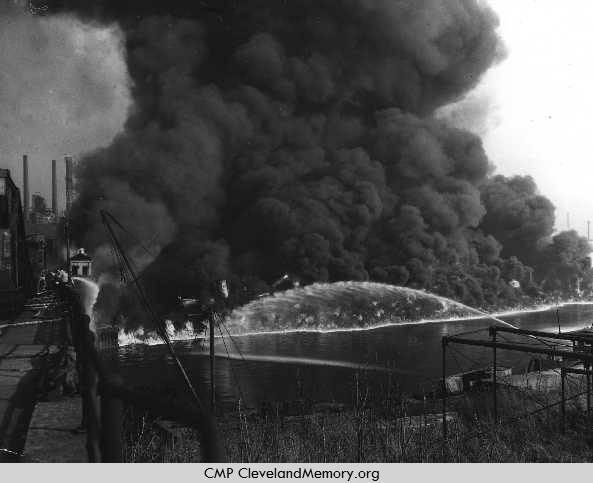
Cuyahoga River fire, November 1, 1952. This photograph, taken during a much larger fire seventeen years before the famous 1969 blaze, is the image TIME magazine used to illustrate the environmental crisis in Cleveland. No photographs of the actual 1969 fire exist, it was extinguished in thirty minutes. James Thomas / Cleveland Press Collection / Michael Schwartz Library at Cleveland State University.
There is a strange footnote buried in that moment. The 1969 fire burned for only thirty minutes, put out so quickly that no photographer captured it. The dramatic photo TIME published was from a larger, more spectacular fire in 1952, seventeen years earlier. The burning river that shocked America into action was, in a real sense, a photograph of something else entirely.
By late 1969, according to historian Adam Rome’s The Genius of Earth Day, Congress was considering nearly 140 environmental bills.
Public opinion was shifting fast. According to the Smithsonian’s account of the era (opens in a new window), a Gallup poll in May 1969 found only 1% of Americans named pollution as the nation’s most pressing problem. By 1971, that number had jumped to 25%.
But shifts in public opinion don’t organize themselves into mass movements.
That required a different kind of catalyst.
The Senator and the Photograph
Senator Gaylord Nelson of Wisconsin conceived the idea: a national environmental teach-in modeled on the anti-war teach-ins that had already proven effective at mobilizing public opinion. He recruited Denis Hayes, a 25-year-old Harvard graduate student who dropped out to organize the event.
Nelson later pointed directly to Earthrise as part of what convinced him the time was right. According to an account of Earth Day’s origins (opens in a new window), “Nelson has said it was the ‘Earthrise’ photo taken during the Apollo 8 mission that really brought the fragility of our planet against the vast darkness of space to life.”
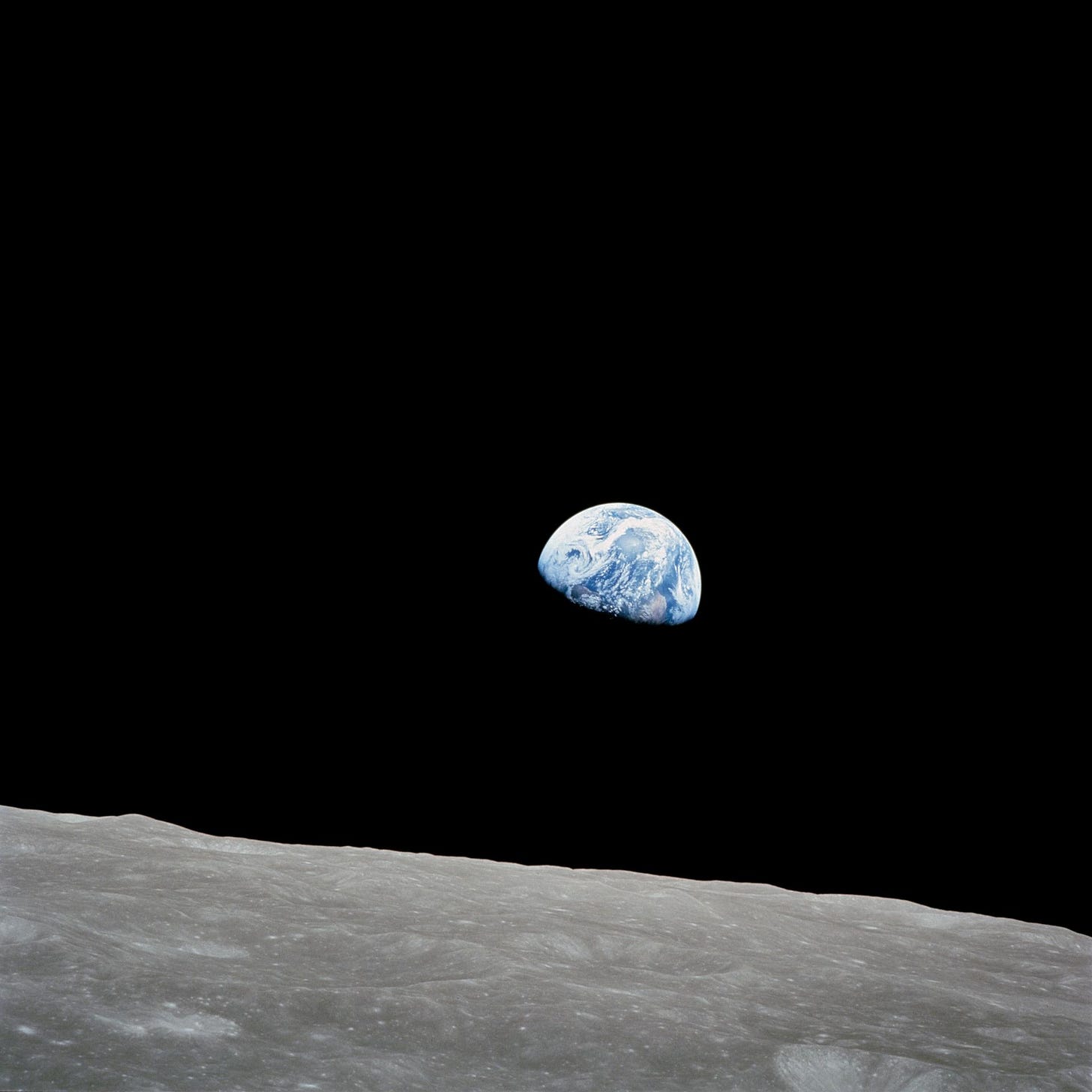
Nelson announced his plan in September 1969. The response surprised him.
- Dec 1968Earthrise is photographed from lunar orbit, Dec 24.
- Jan 1969Oil platform blowout off Santa Barbara, Jan 28.
- Apr 1969Spring: Earthrise on the cover of the Whole Earth Catalog.
- May 1969Gallup: 1% of Americans name pollution the top problem.
- Jun 1969The Cuyahoga River in Cleveland catches fire.
- Sep 1969Sen. Gaylord Nelson announces a national teach-in.
- Apr 1970Earth Day, Apr 22. Twenty million Americans take part.
Student organizers on college campuses seized the concept. They didn’t wait for instructions from Washington. They organized locally, addressing issues that mattered to their communities: air pollution in Los Angeles, water contamination in the Great Lakes, industrial waste in Appalachia.
April 22, 1970, a Wednesday chosen to fall between spring break and final exams, became the target date.
This is where Earthrise enters the story, not as a poster image, but as something more subtle and more powerful.
The Photograph’s Invisible Influence
Here’s what didn’t happen: Student organizers didn’t plaster Earthrise on their Earth Day posters.
The two most iconic Earth Day 1970 posters, by Robert Rauschenberg and Milton Glaser, both depicted something else entirely. According to the Earth Day Network (opens in a new window), Rauschenberg showed an endangered bald eagle surrounded by pollution. Glaser showed Earth trapped in a room. Both focused on environmental degradation, not cosmic perspective.
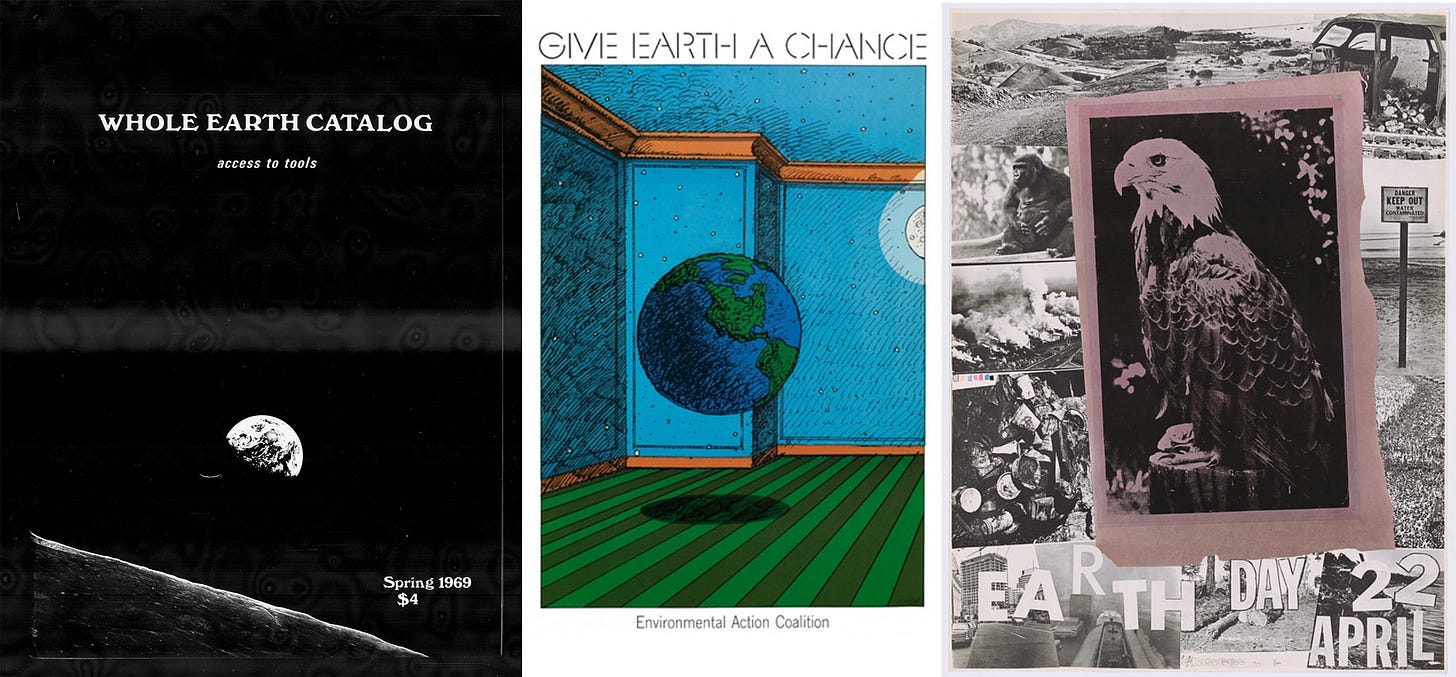
Three images from the movement’s first years. Left: Whole Earth Catalog, Spring 1969, Earthrise on its cover. Center: Milton Glaser’s Give Earth a Chance, created for Earth Day 1970: Earth not rising above the lunar horizon, but trapped in a room with no way out. Right: Robert Rauschenberg’s Earth Day poster, 1970: an endangered bald eagle surrounded by highways, junkyards, and smoke. The photograph that supposedly sparked the movement wasn’t on either poster. It didn’t need to be.
But Earthrise had already done its work.
The photograph appeared on the cover of the Whole Earth Catalog, starting with the Spring 1969 edition, the counterculture publication that connected environmental awareness to systems thinking. It influenced the movement’s leaders. And it became the image that people retroactively associated with Earth Day: the symbol they remembered, even if they encountered it after the event, not during it.
As historian Robert Poole documents in Earthrise: How Man First Saw the Earth, the years 1968–1972, when astronauts photographed Earth from space, saw “the emergence of the modern environmental movement.” He argues it is “no coincidence” that these events overlapped.
The photograph didn’t organize rallies.
But it changed how people saw the planet they were organizing to protect.
April 22, 1970
Twenty million Americans (opens in a new window) participated in Earth Day 1970.
In New York City, Fifth Avenue was closed to traffic. According to the Natural Resources Defense Council (opens in a new window), more than 100,000 people staged what organizers called a “human jam.”
In Philadelphia, tens of thousands gathered in Fairmount Park for speeches and concerts.
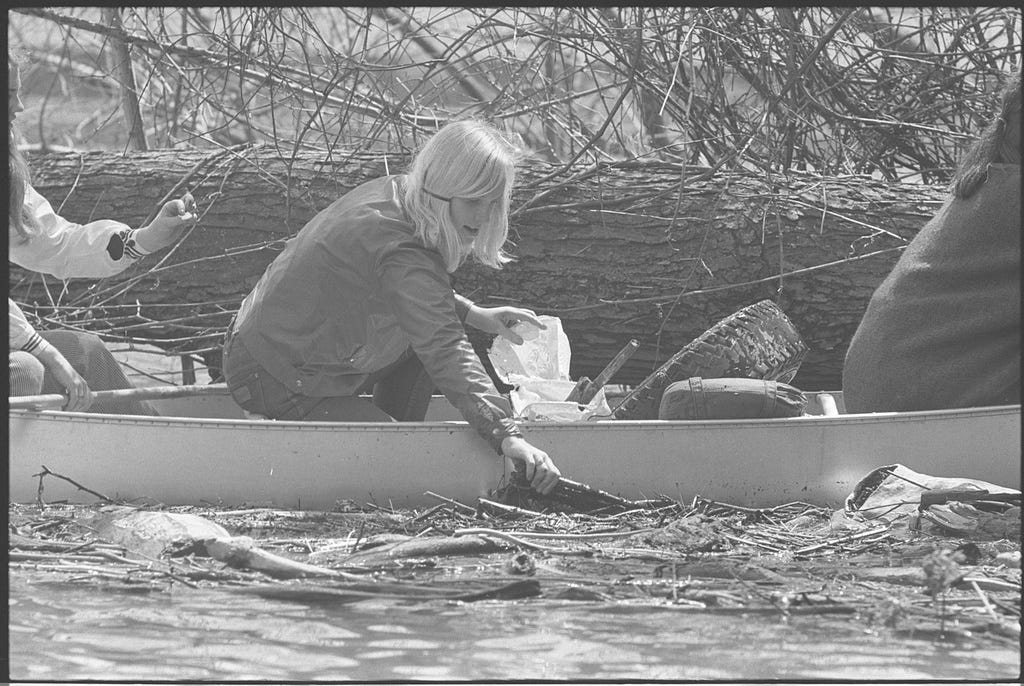
In St. Louis, volunteers planted 10,000 trees along the Mississippi River.
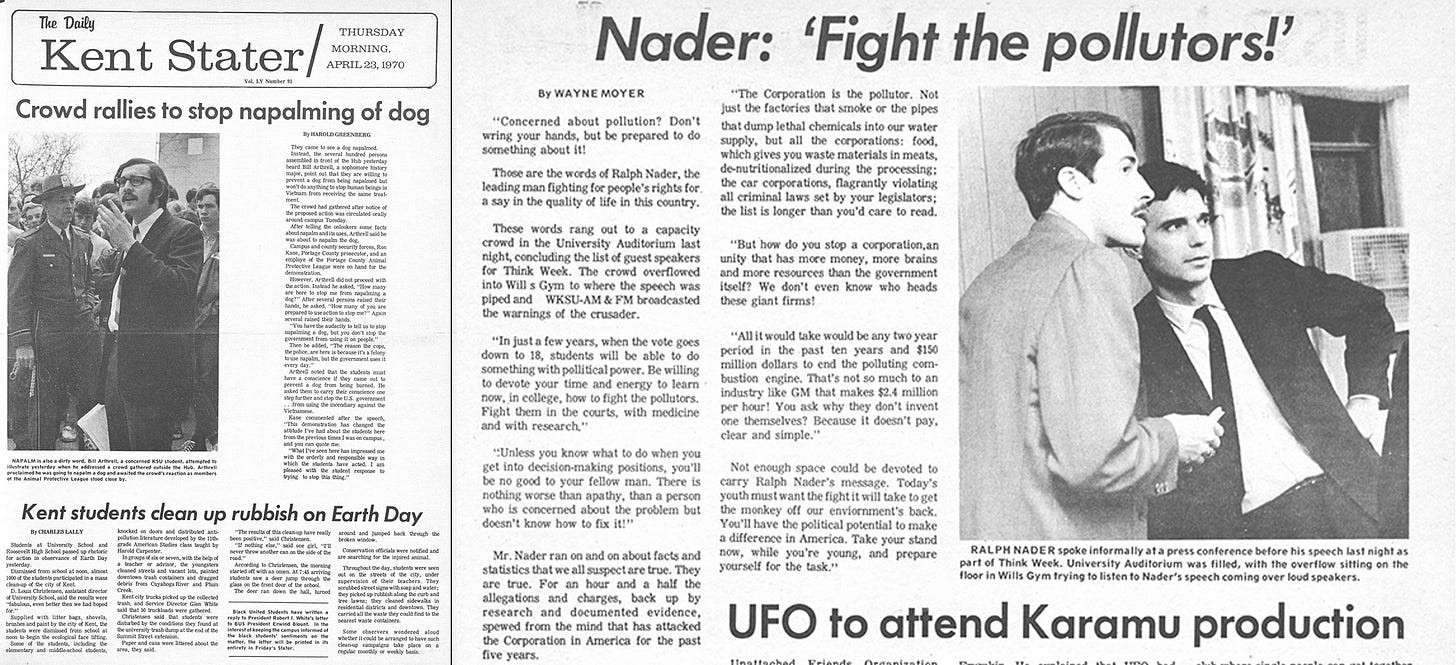
At Kent State University in Ohio, students under the banner “Environment is a Dirty Word” hosted Think Week, a four-day series of lectures, debates, and ecological displays running April 20 through 23. Former Interior Secretary Stewart Udall spoke. So did Ralph Nader, whose address on chemical pollution filled University Auditorium past capacity, the overflow crowd sat on the floor of Wills Gym and listened to the speech piped in over loudspeakers. Across the country, according to historian Adam Rome in The Genius of Earth Day, students staged funerals for “the children of tomorrow” to protest pollution. At Kent, students went further. Almost 1,000 students from University School and Roosevelt High School were dismissed from class at noon to clean the city. They scrubbed street signs, painted trash containers, and dragged debris from the Cuyahoga River itself, the same waterway, sixty miles north, that had caught fire eleven months earlier. Twelve days later, four Kent State students would be dead, shot by Ohio National Guard troops during anti-war protests.
The same campus. The same spring.
What Happened Next
Earth Day 1970 forced politicians to act.
President Nixon, a Republican, created the Environmental Protection Agency (opens in a new window) by executive order in December 1970. Over the next decade, Congress passed the Clean Air Act (1970), Clean Water Act (1972), Endangered Species Act (1973), and the Safe Drinking Water Act (1974).
The environmental movement didn’t end. It evolved, splintered, politicized. By the 1980s, the bipartisan consensus that made Earth Day possible had fractured.
But for one day in April 1970, twenty million Americans looked up at a photograph of Earth from space and decided to do something about the planet they were standing on.
What I See Now
I work at Kent State University, photographing campus life, research, and student achievements.
The same campus where students organized Earth Day teach-ins with Stewart Udall and Ralph Nader.
The same campus where, days later, the National Guard opened fire on students protesting the Vietnam War.
Environmental hope and political violence, sixteen months after Earthrise, twelve days apart.
That’s the real story of how a photograph becomes part of a movement. Not through the image alone, but through the collision of inspiration, crisis, tragedy, and organizing.
Earthrise didn’t create Earth Day.
But it helped convince the people who did that Americans were ready to see their planet differently.
The environmental movement had already begun.
Earthrise simply showed the world what it looked like.
What’s Coming
Earthrise sparked a movement. It gave millions of people a way to see what they were fighting for.
But sixteen years later, another photograph from space would do something completely different. No marches, no legislation, no Earth Day equivalent. Just one scientist’s years-long fight to get NASA to turn a camera around; and the loneliest photograph ever taken.
When this ran in March, these were promises. They’re all published now.