The Accidental Masterpiece: How Earthrise Happened
“Oh my God! Look at that picture over there! Here’s the Earth coming up. Wow, is that pretty!”
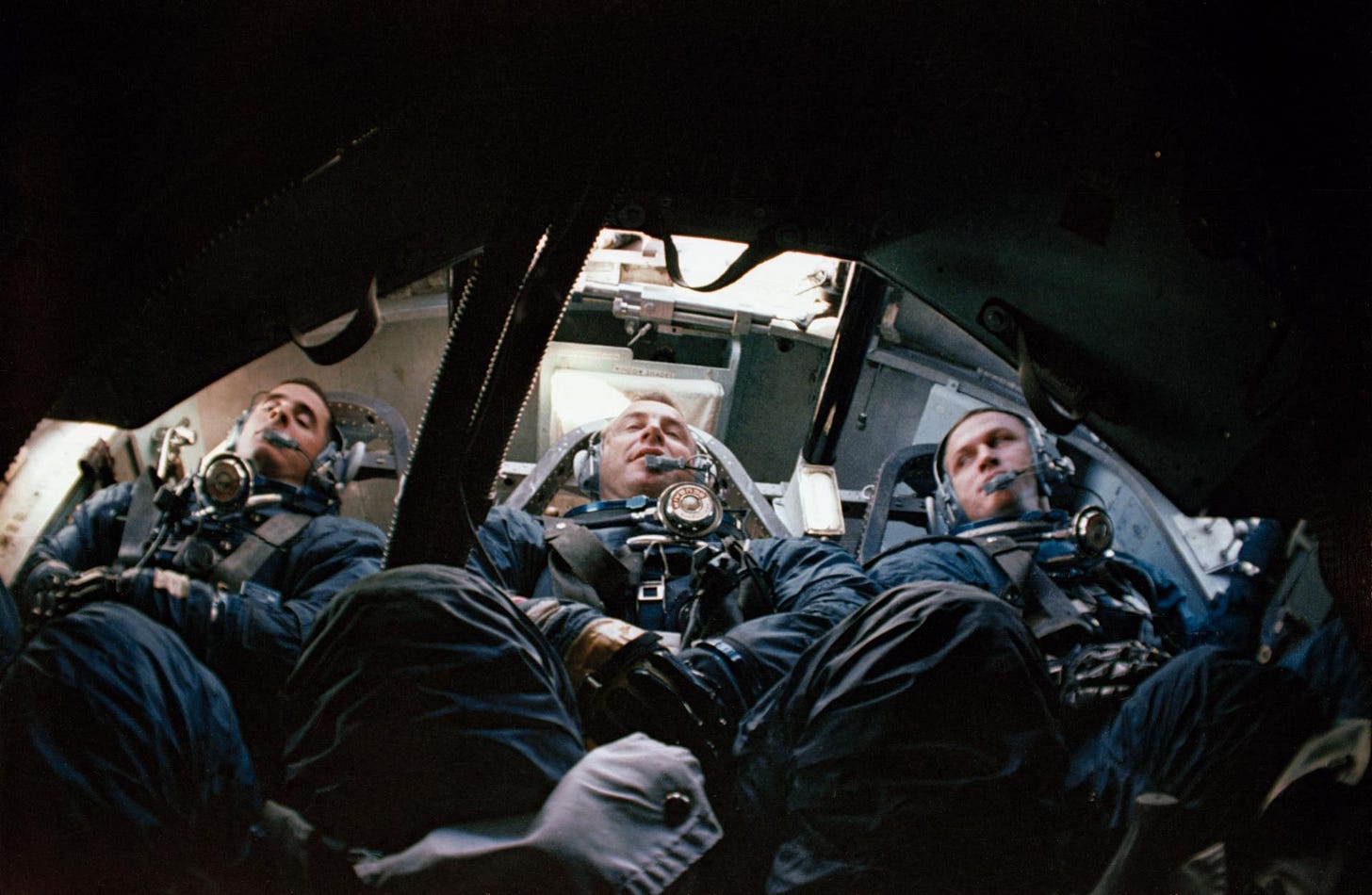
Bill Anders didn’t plan to say it. But when Earth appeared in the window, his words came out unfiltered: “Oh my God! Look at that picture over there! Here’s the Earth coming up. Wow, is that pretty!” (opens in a new window)
He wasn’t supposed to be photographing Earth.
He was 240,000 miles from home, orbiting the Moon on Christmas Eve 1968, and his assignment was straightforward: photograph the lunar surface (opens in a new window). Gray craters. Barren ridges. Potential landing sites for Apollo 11. Frame after frame of lifeless terrain that mattered enormously to mission planners and meant almost nothing to anyone else.
But during the fourth orbit, commander Frank Borman initiated a routine roll maneuver. The spacecraft rotated. The view through the window shifted.
And suddenly, there it was.
Earth.
Rising above the Moon’s horizon like nothing any human had ever seen before.
What happened in the next sixty seconds would produce one of the most influential photographs ever taken. Not because it was planned. Not because anyone anticipated its significance.
But because one photographer understood; instantly; that the assignment had just changed.
What They Went For
Three weeks earlier, Apollo 8 (opens in a new window) had launched with a very specific mission: reconnaissance.
Frank Borman commanded. James Lovell navigated. Bill Anders, a fighter pilot and engineer, handled photography. They were the first crew to leave Earth orbit, the first to see the far side of the Moon, and the first humans ever to orbit another world.
Their objective was technical. NASA needed high-resolution images of the lunar surface; photographs sharp enough to reveal terrain features that could threaten a landing module or provide stable ground for Apollo 11.
This wasn’t about wonder. It was about data.
Anders carried a modified Hasselblad 500 EL (opens in a new window); a Swedish-designed medium format camera adapted for the vacuum of space. The camera had been stripped of non-essential components, fitted with specialized controls operable in bulky gloves, and loaded with custom film magazines holding 70mm film (opens in a new window). Anders had been photographing the lunar surface with a 250mm Zeiss Sonnar telephoto lens (opens in a new window) when Earth appeared.
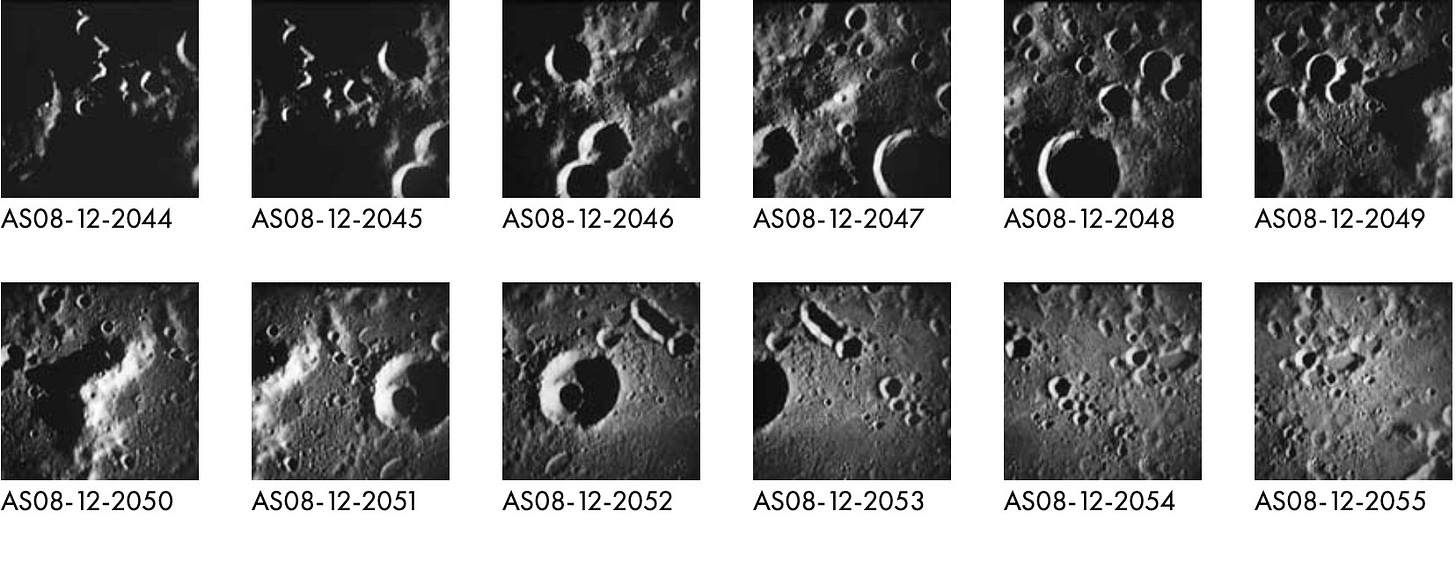
The Moon, as it turned out, was an unforgiving photographic subject.
Airless. Colorless. Monotonous.
Anders later described it with blunt honesty: there wasn’t much to look at.
For three orbits, that was the work. Crater after crater. Surface after surface. Image-making as engineering; technical, deliberate, unglamorous.
History might have recorded Apollo 8 simply as a successful reconnaissance mission.
Then came the roll maneuver.
The Scramble for Color
The moment Earth appeared above the lunar horizon, Anders knew.
Not thought. Not wondered.
Knew.
This was different from everything they had been photographing.
He exposed a frame on the black-and-white film already loaded in the camera. But even in that split second he understood it wouldn’t be enough.
Color mattered.
The mission transcript (opens in a new window) captures what happened next:
- Anders
- Just grab me a color. A color exterior. Hurry up. Got one?
- Lovell
- Yeah, I’m looking for one... Here.
- Anders
- Well, I think we missed it.
- Lovell
- Hey, I got it right here!
- Anders
- Let me get it out this one, it’s a lot clearer.
- Lovell
- Bill, I got it framed, it’s very clear right here!
- Borman
- Well, take several of them.
- Lovell
- Take several of them! Here, give it to me!
- Anders
- Wait a minute, just let me get the right setting here now, just calm down.
- Anders
- Calm down, Lovell!
Anders loaded a magazine of Kodak Ektachrome (opens in a new window), framed quickly, and made the exposure that would become known as Earthrise.
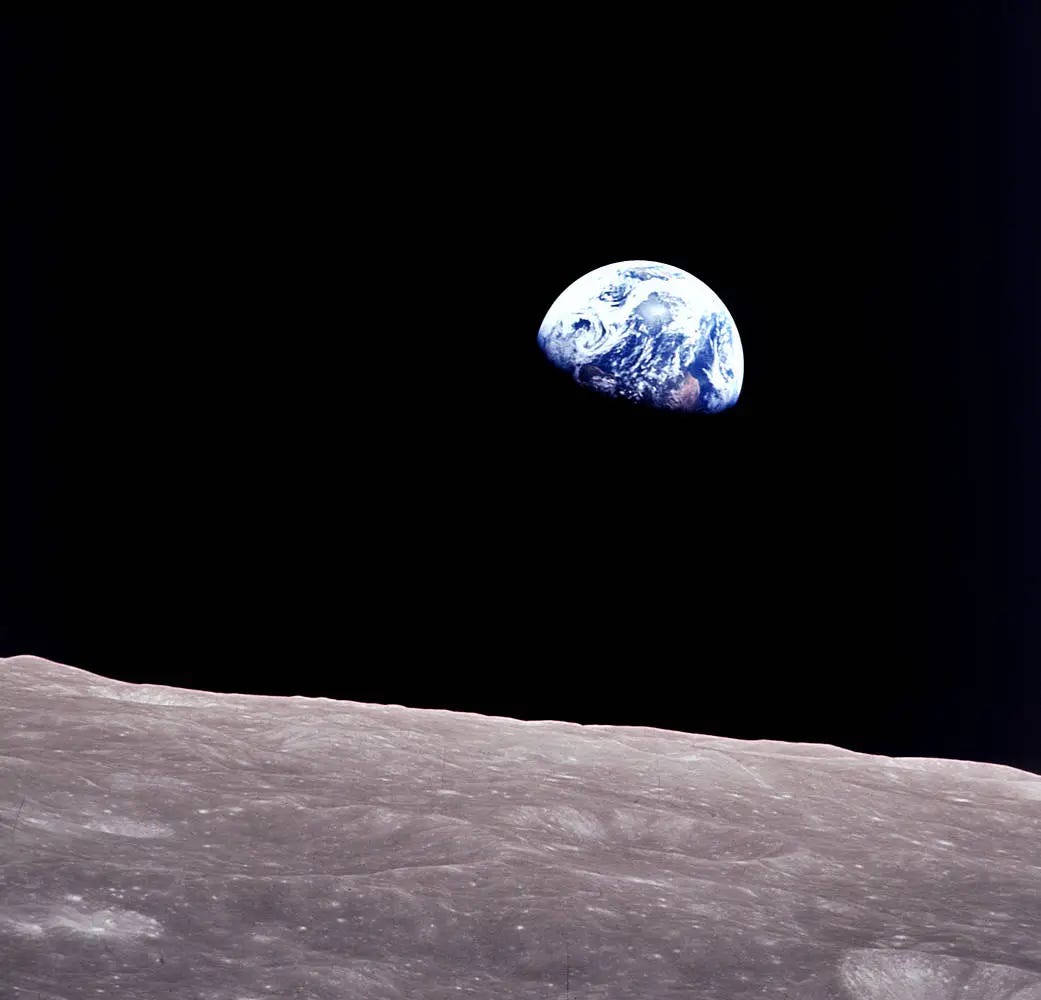
As a photographer, I recognize that moment immediately. The instant when what you’re seeing through the viewfinder stops being just another frame.
It becomes the frame.
The one that justifies carrying the camera in the first place.
Anders understood instinctively that color wasn’t cosmetic. The subject was contrast: a vibrant blue-and-white Earth suspended above a dead gray foreground.
Strip away the color and the meaning collapses.
Black and white would have been documentation. Color made it revelation.
Why the Technical Choices Mattered
The Hasselblad 500 EL wasn’t chosen arbitrarily. It was a workhorse camera modified specifically for the brutal conditions of spaceflight; reliable, precise, and simple enough to operate in bulky gloves.
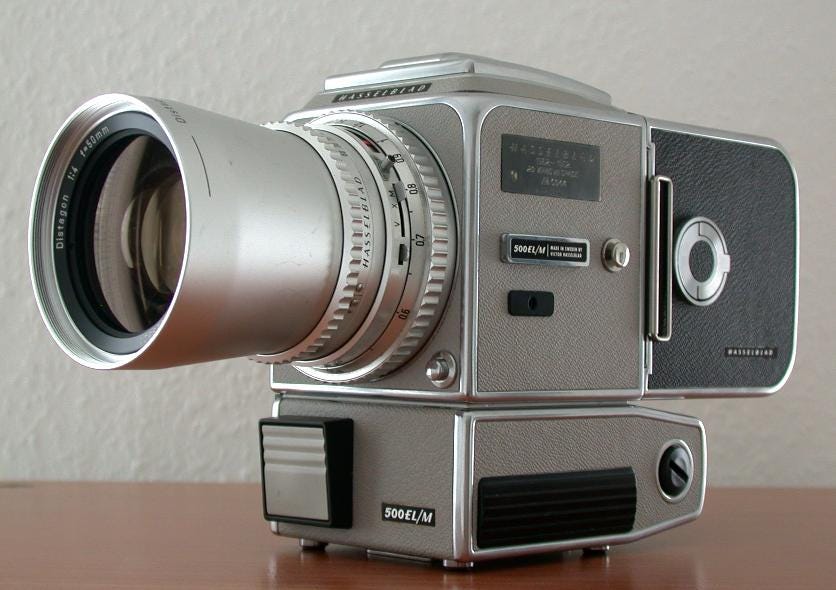
But its design carried an unexpected advantage: large-format 70mm film.
Compared to standard 35mm photography, the larger negative captured extraordinary detail and tonal range. The result was an image that held up not just scientifically, but emotionally. Clouds, oceans, and continents retained texture even when reproduced around the world.
The 250mm Zeiss Sonnar lens contributed another critical element: reach and sharpness. Originally mounted for detailed lunar surface photography, it brought Earth close enough to fill the frame meaningfully while maintaining edge-to-edge clarity.
But the most important element was the Kodak Ektachrome color film.
Color film in the 1960s struggled with extreme lighting conditions. Yet Ektachrome preserved the deep blacks of space, the brilliant whites of clouds, and the impossible blue of Earth’s oceans.
The film didn’t just record the scene.
It preserved its emotional structure.
I’ve spent enough time documenting aerospace research to understand the gap between what engineers need and what the public sees. Engineers needed resolution, precision, and accurate color. The public needed meaning. Earthrise, it turned out, was capable of delivering both.
The Photographer’s Instinct
There’s another reason the photograph works so powerfully.
Earth isn’t centered.
It rises diagonally above the Moon’s horizon, slightly off-axis.
This wasn’t a carefully composed landscape. Anders had only seconds. The spacecraft was moving. The framing was instinctive.
But that slight imbalance makes the image feel dynamic; like a moment unfolding rather than a scene arranged.
The photograph doesn’t feel staged.
It feels discovered.
Photography often rewards preparation, but the most powerful images sometimes emerge from the opposite: recognizing when reality suddenly becomes more important than the assignment.
Christmas Eve, 1968
The photograph reached Earth at the end of one of the most turbulent years in modern American history (opens in a new window).
1968.
The assassinations of Martin Luther King Jr. and Robert F. Kennedy. The escalation of the Vietnam War. Protests and riots across American cities. Political division that seemed impossible to bridge.
And then, on Christmas Eve, three astronauts broadcast live from lunar orbit.
They read from the Book of Genesis.
They showed humanity an image of Earth rising over the Moon.
The symbolism wasn’t planned.
But the photograph arrived exactly when it was needed most.
From 240,000 miles away, borders disappeared. Conflicts shrank. The planet looked small, luminous, and fragile.
The astronauts had gone to document another world.
Instead, they revealed our own.
What Accidents Teach Us
Bill Anders didn’t set out to take one of the most influential photographs ever made.
He set out to do his job.
Photograph the Moon. Bring back data.
The image that would reshape environmental consciousness and change how humanity saw itself in the cosmos was an accident of timing and perspective.
But Anders recognized it.
He could have dismissed the view as a distraction from the mission. Could have stayed focused on the assignment and let the moment pass.
Instead, he stopped, called for color film, and captured the frame; all because someone recognized the moment and refused to let it pass.
That’s the photographer’s instinct: recognizing when what you’re seeing matters more than the plan.
I’ve felt that moment myself. Standing in a wind tunnel or test facility at NASA Glenn Research Center, camera in hand, watching something unfold that I know needs to be preserved exactly as it is. The work you were sent to do suddenly becomes secondary to the moment presenting itself.
That instinct separates photographers who document from photographers who witness.
Anders witnessed.
And in doing so, he gave the world an image it didn’t know it needed; one that would spark a movement, reshape policy, and redefine how humanity sees its place in the universe.
The photograph was taken in sixty seconds. Its consequences are still unfolding.
Sources and further reading
- NASA Goddard Space Flight Center, Scientific Visualization Studio. “Earthrise: The 45th Anniversary.” 2013. Mission transcript, including the scramble for color film. Link to this source (opens in a new window)
- NASA Science. “The Story Behind Apollo 8’s Famous Earthrise Photo.” February 12, 2025. Mission context and crew details. Link to this source (opens in a new window)
- Chaikin, Andrew. “Who Took the Legendary Earthrise Photo From Apollo 8?” Smithsonian Magazine, December 11, 2017. The definitive account of the photograph’s creation. Link to this source (opens in a new window)
- B&H Photo Video. “The Cameras of the Apollo Moon Missions.” March 19, 2024. Technical details on the Hasselblad, Zeiss lens, and Ektachrome film. Link to this source (opens in a new window)
- Gillon, S. M. “Behind the Photo: Apollo 8’s ‘Earthrise‘ Over the Moon.” History.com, May 28, 2025. Historical context for Christmas Eve 1968. Link to this source (opens in a new window)